Fill in the blanks:
______ ______ is defined as the number of strides taken in a given amount of times or distance.
Stride rate
Choose the correct answer:
Proper mechanics for the foot/ankle complex during running movements include the foot and ankle pointing straight forward in a ______ position when it hits the ground.
a. plantar flexed
b. dorsiflexed
b. dorsiflexed
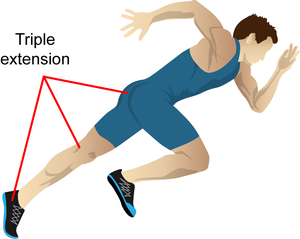
What are proper backside mechanics during running?
Triple extension of the ankle, knee, and hip with a neutral pelvis
Define:
Speed
The ability to move the body in one intended direction as fast as possible
What is the primary focus when designing SAQ (speed, agility, and quickness) programs for weight loss?
Keep heart rate elevated.
SAQ drills are particularly beneficial for seniors due to their ability to prevent age-related decreases in these three factors.
- Bone Density
- Coordinative Ability
- Muscular Power
How do you calculate speed?
Distance / time
Define:
Stride length
The distance covered with each stride while running.
Fill in the blanks:
Beginning clients should perform ______ drills. Each drill should have ______ sets and ______ reps.
4-6
1-2
2-3
Describe the proper body positioning of the LPHC during running movements.
The body should have a slight lean during acceleration.
During maximal velocity, the LPHC should be fairly neutral, without excessive flexion or extension unless to reach for an object.
Fill in the blanks:
Intermediate clients should perform ______ drills. Each drill should have ______ sets and ______ reps.
6-8
3-4
3-5
What are proper frontside mechanics?
- Triple flexion of the ankle, knee, and hip w/neutral pelvis
- Foot, ankle, and knee of lead leg should be pointing straight ahead

Fill in the blank:
The ability to react to a stimulus and appropriately change the motion of the body with the maximal rate of force production, all planes of motion, and from all body positions is defined as ______.
quickness
Fill in the blanks:
Advanced clients should perform ______ drills. Each drill should have ______ sets and ______ reps.
6-10
3-5
3-5
The “Red Light, Green Light” and “Follow the Snake” drills are examples of appropriate SAQ drills for which population?
Youth
Fill in the blank:
______ refers to the ability to start (accelerate), stop (decelerate), and change direction quickly while maintaining proper posture.
Agility

-
Chapter 1 - The Modern State of Health and Fitness64
-
Chapter 2 - The Personal Training Profession24
-
Chapter 3 - The Psychology of Exercise31
-
Chapter 4 - Behavioral Coaching39
-
Chapter 5 - The Nervous, Muscular, and Skeletal Systems78
-
Chapter 6 - The Cardiorespiratory, Endocrine, and Digestive Systems76
-
Chapter 7 - Human Movement Science88
-
Chapter 8 - Exercise Metabolism and Bioenergetics53
-
Chapter 9 - Nutrition57
-
Chapter 10 - Supplementation28
-
Chapter 11 - Health, Wellness, and Fitness Assessments46
-
Chapter 12 - Postural, Movement, and Performance Assessments47
-
Chapter 13 - Integrated Training and the OPT Model38
-
Chapter 14 - Flexibility Training Concepts45
-
Chapter 15 - Cardiorespiratory Fitness Training37
-
Chapter 16 - Core Training Concepts28
-
Chapter 17 - Balance Training Concepts18
-
Chapter 18 - Plyometric (Reactive) Training Concepts15
-
Chapter 19 - Speed, Agility, and Quickness Training Concepts16
-
Chapter 20 - Resistance Training Concepts53
-
Chapter 21 - The Optimum Performance Training Model58
-
Chapter 22 - Introduction to Exercise Modalities25
-
Chapter 23 - Chronic Health Conditions and Special Populations50


